
hate self-promotion? develop a talk.
what to do when the attention economy eats the job market (but linkedin is too cringe for you)

The job market is an attention economy now. There are so many plausibly qualified people for any given role that the hard part is no longer being good enough, it’s getting noticed. Whether you want to go work for a company or do your own thing, the problem you need to solve is capturing the attention of the people who you want to hire or pay you.
That means you have to start thinking about the entire path someone takes from never having heard of you, to learning how you think, to deciding to work with you. Like it or not, your career is a funnel now.
I can hear you groaning!! I’m drowning in a sea of groans! “Ughhh Hilary I know where this is going. Please don’t tell me I need to work on my personal brand. I hate self-promotion, and the idea of contriving a corporate-friendly personal brand makes me want to die.”
Don’t worry. I wouldn’t do that to you. In fact I am here to save you from the hordes of people telling you to look within your soul until your personal brand emerges fully formed, clad in armor, like Athena from the forehead of Zeus.
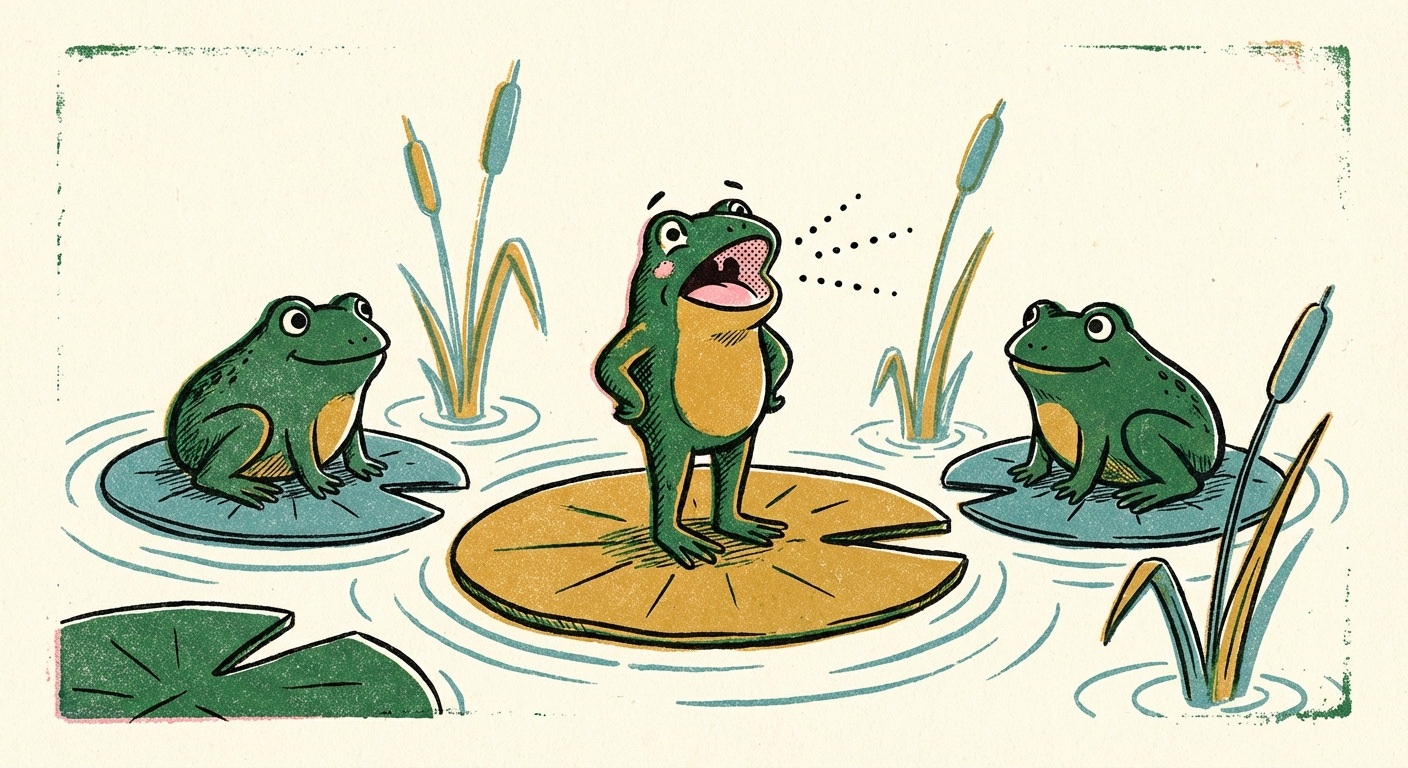
You do, however, need a strategy for how you will break through the noise and get noticed in an oversaturated job market. My humble suggestion: develop a talk.
Here’s what I do not like about Personal Brand Discourse (is that a thing?). Much of the advice you get about Branding Yourself, especially as a woman, tells you to look inward. Think about who you are and what you stand for and what you want to convey to the world. Sit with your journal and figure out your unique value proposition. Introspect!!
I think this is very bad advice, for a few reasons.
First, for this whole exercise to be successful, you need to get information from the world. You don’t know yet which parts of your knowledge have real demand, nor how to talk about them in the way that will capture that demand. You don’t know whether the things you think are interesting are interesting to others. You need signal, and you can only get signal by putting yourself out there and seeing what happens.
Second, tying your professional positioning to your identity is a trap. Because then when it gets rejected, it feels like an attack on you. You actually want it to get rejected, because that process of putting it out there, getting feedback, and iterating is how you develop it into the strongest version of itself. You can’t do that if every “no” feels like a referendum on you as a person. You will instead avoid putting yourself out there in order to protect your ego.
So here’s my alternative: instead of thinking “who am I, and what do I want the world to see me as?” think about this: “if I had to give a talk tomorrow, what would I give a talk on?
Then go develop that talk. And give it.
(Yes, I made a Custom GPT to help you figure out what to talk about.)
your mini talk circuit
Start where you are. If you’re in a job, give the talk at your job. Pick something you know well, something you’ve figured out that other people are still struggling with. “How we fixed our onboarding flow.” “What I learned managing a team through a reorg.” “How I use AI to do X.” It doesn’t need to be grand. It needs to be specific and based on something you’ve actually done.
Give this talk to your team. See what happens. Do people show up? Is there energy in the room? Do you hear good things afterward? Those are all good signs, obviously. If you get these green flags, can you give it to another team at your company? Do the green flags continue?
Then expand outward. Reach out to a friend at another company and say, “I’ve been working on a talk about X. Would your team find it useful?” This is a much easier door to open than “hey, are you hiring?” You’re offering something, not asking for something.
Over time, you refine it. You take feedback. You notice which parts land and which parts lose the room. You build it out. Eventually you develop a point of view that gets you in rooms, because you’re the person who gives that talk. And because you have practiced and workshopped this talk with friendly audiences, you crush it. So those people remember you. They mention you when a role opens up, or when someone asks “do you know anyone who’s good at X?” You’re building the top and middle of your funnel without ever having to call it that or even really think about it.
why this is better than a “personal brand”
The talk is a product, not an identity. You can test it, iterate on it, and improve it based on real feedback from real people. If you give a talk and nobody shows up, that’s useful information: there probably isn’t demand for that topic, and you should try a different one. Or maybe you just need a better framing for it. Either way, that’s so much healthier than basing your whole professional identity on a positioning that you workshopped in your journal and never validated.
It’s also lower-stakes in a way that matters. When you apply for a job and get rejected, it’s hard not to take it personally. When you offer to give a talk and the response is lukewarm, it’s just an idea that didn’t land. (I have, like, a 20% hit rate on my ideas landing. Maybe 10%.). You try a different angle or a different audience. The emotional distance between “they didn’t want my talk” and “they didn’t want me“ is significant, and it lets you actually learn from the feedback instead of spiraling.
There’s also no treadmill. When you decide to start a newsletter or a podcast or post more regularly on social media, you’re signing up for a recurring commitment. You have to keep producing, consistently, or it stops working. A talk is a single thing you develop once and give over and over. You’re not committing to an output schedule. You’re building one asset that gets better each time you use it.
And! Best of all! Whatever your talk is about, that’s probably a skill people will pay for. If your talk is “here’s how to fix your onboarding,” that’s consulting work. If it’s “here’s how I use AI for X,” that’s training. If it’s something people consistently want to hear about, that’s a signal that you’ve found a real problem, and you’re the person who knows how to solve it. The talk is how you figure out what that is. It could become something you sell as a consultant, something you write about if you want to become a content creator, or exactly what makes you stand out for your next job.
The Personal Brand Industrial Complex gets the diagnosis right: you do need to be known for something. But the prescription is backwards. Your positioning is not a truth buried inside you waiting to be discovered. It’s a hypothesis that needs to be tested. The talk is how you test it. You put an idea in front of people, watch what happens, and adjust. Over time, what you’re “known for” is something you earned in a room, not something you decided in a journal.
But it starts with the talk.
And look, I know this feels like one more thing on the pile. But most people are spending 100% of their professional energy on work that’s only visible inside their company. The irony is that the busyness that prevents you from building any visibility outside your team is the same busyness that makes you more dependent on your employer and more vulnerable if the job goes away. Developing a talk isn’t adding to your plate. It’s reallocating some of your effort from work that only your team sees to work that compounds.
why this matters right now
We often talk about “the attention economy” as it pertains to social media companies competing to attract and monetize our attention as consumers. But the economist Herbert Simon described attention economy dynamics all the way back in 1971, noting: “A wealth of information creates a poverty of attention.”
His insight was that when there are only a few options, the hard part is finding a good one. When there are thousands, the hard part is choosing; choosing requires attention, which is finite. So attention becomes the scarce resource.
This is what happened in consumer markets. Think about buying a mattress in 1995 versus today. In 1995, there were 15 options at the store. You would go in, sit on a few, pick one, leave. Now there are thousands online, and you can’t possibly evaluate them all, so you default to the one you’ve heard of, or the one a friend recommended. The scarce resource is no longer good mattresses. It’s your attention.
The same shift happened in hiring. Five years ago, applying for a job required real effort, which kept the volume manageable. Now LinkedIn lets you apply in two clicks, AI generates resumes in seconds, and hiring managers are buried under hundreds of plausibly qualified candidates they can’t meaningfully evaluate. So they default to heuristics: the person they’ve already heard of, the person a trusted colleague recommended, the brand name they recognize on the resume.
This is why The Talk matters. In an attention economy, every gimmicky tactic for getting attention eventually gets copied until it stops working. But relationships built on trust endure. A talk is one of the few things that gets better every time you do it, builds relationships with every audience, and positions you as someone with a point of view worth hearing.
You don’t have to become an influencer, or obsess over your “brand.” You just have to develop a talk.
If you need help, use my Custom GPT to come up with ideas. (The prompt is behind the paywall).
xoxo,
hils
