

monkey grapes
how to overcome your addiction to comparison, and why seeing your neighbors win the lottery will make you lose your mind

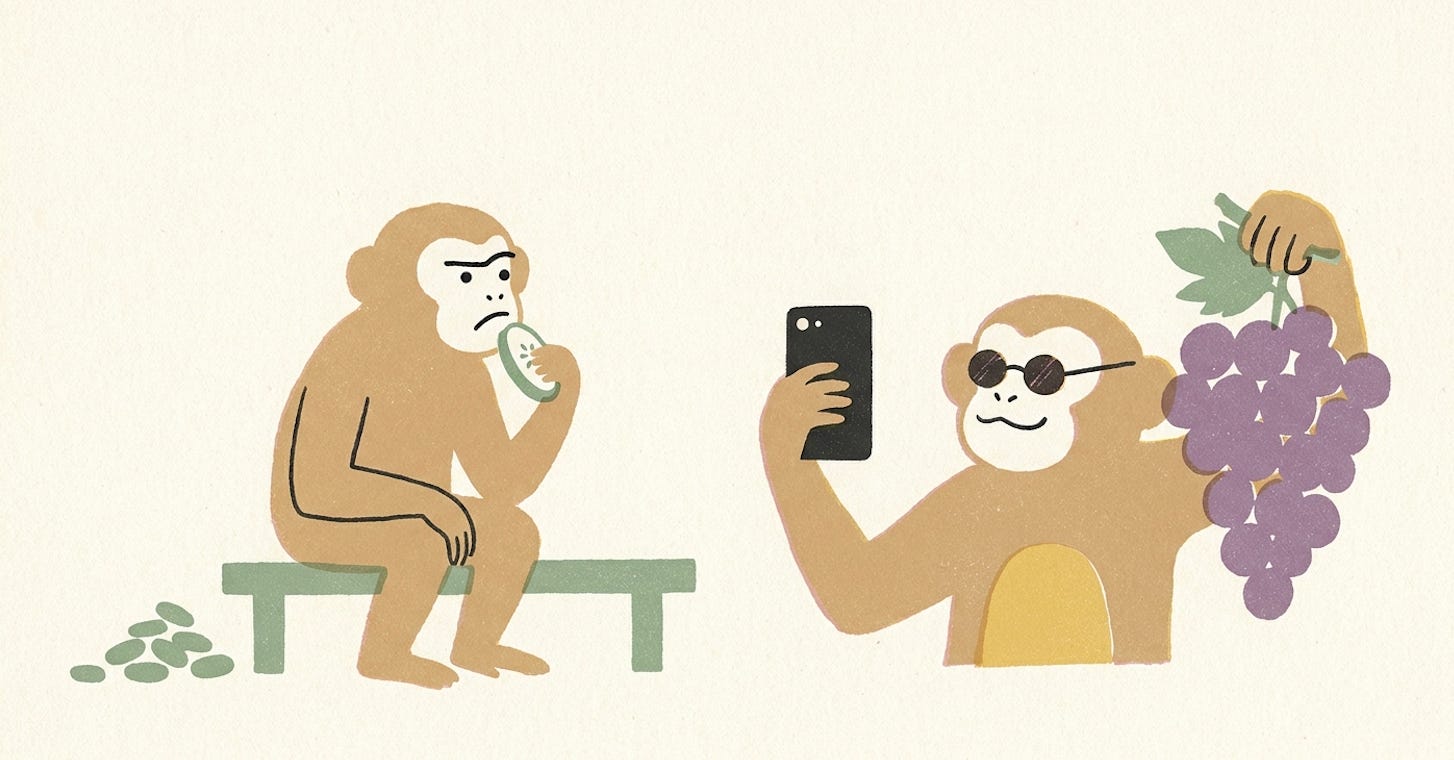
There is a YouTube video I think about almost every day. Two Capuchin monkeys complete tasks in their cages. When they finish, they receive a cucumber. Life is good.
But then! Paradise lost. The second monkey starts getting a grape for the same task. The first monkey continues to get cucumbers. When he sees the second monkey receiving a grape, he flies into a rage, throwing the cucumber back at the handler and shaking the bars of his cage.
This is what it feels like to live in San Francisco. Or simply to be on social media. People are perfectly happy with their lives, right up until the moment they see someone else getting a grape while they are the chump stuck with a cucumber.
When I lived in San Francisco, I found it haunting how easily this creeps in, even for those of us who try to remain vigilant about these things. If you live there for any amount of time, you will know people who made insane amounts of money by being in the right place at the right time. Watching your neighbors win the lottery while you feel like you worked just as hard and have comparatively little to show for it can break your brain.
You might know intellectually that comparison is the thief of joy, and tell yourself you should just stop. But knowing this doesn’t change that it’s very, very, very hard to actually do. You know you shouldn’t compare yourself to others, and yet you do.
This is why I find the Capuchin monkeys reassuring. There is something so deep inside of us driving this instinct that it transcends our species, which means you cannot simply will yourself out of feeling this way. It will take a different approach.
Anxiety as addiction
I often reference this Ezra Klein podcast where he interviews an addiction psychiatrist, Jud Brewer, about dealing with anxiety. Brewer makes a compelling case that anxiety functions as a kind of addiction. Like any addiction, you cannot break free from it until you understand the short-term reward driving the otherwise self-destructive behavior.
When trying to break free from a negative thought pattern, I’ve found people tend to do the opposite: they focus on why it’s bad, trying to convince themselves not to do it. But this rarely helps, and often just makes you feel worse.
It is fairly obvious why comparing yourself to others is so bad for your wellbeing. Chief among the reasons: the prize of success is entry into social circles of more successful people. So if you define your own success by the material gains of the people most visible to you, no matter how well you do, you will always feel like a loser.
But at least with that proximity, you see what the gamble actually costs, even when it pays off. You see the striver mentality that erodes their ability to enjoy their wealth, the sacrificed time with family, the stress that hangs over them like a cloud, the health problems, the steady diminishing of the light inside them, the warping of their values. Even if those trades seem to make sense for them given their goals, disposition, whatever, you can at least see that you personally would not make them.
The day I interviewed at Dropbox, they were serving king crab legs for lunch. The sight was ridiculous. My office tour took me past vending machines that dispensed free Mac products and into a cafeteria bustling with upwardly mobile tech workers carrying crab legs as long as their torsos in one hand and open laptops in the other. Coming from the nonprofit world, I was shocked and intrigued. Surely if I get this job, I will know I have made it, I remember thinking.
I worked at Dropbox for three years and my biggest takeaway was that the most well-distributed target of human creativity is the invention of reasons to be miserable. Much like the Capuchin monkeys, the moment we became aware of someone with a better deal than us, we grew agitated. It shook me! I saw it everywhere, from the person whose day was ruined because the free sushi bar ran out of fatty tuna before they got there to the person whose former coworker got into the now-hot startup at the right time and appeared financially set for life. I was not immune. I would get completely bent out of shape over who got promoted and how quickly. The worst part is that when my turn came and I got the coveted promotion, it didn’t even feel like a victory. It was just, onto the next thing.
But at least many of us saw the cost. We talked openly about how ridiculous it was, how we could feel it warping us, how we looked forward to eventually getting out.
We were generally clear-eyed about what was keeping us there: some combination of the work, the impact, the pay, the perks.
These days, I don’t think people are quite so clear about what’s keeping them in the monkey grapes game. Why are so many people still driven by a compulsive comparison to other people’s apparent wins?
Come on in, the water’s fine
One well-known element of social media is that you only see the manufactured upside of other people’s choices. It hides two things from you: the reality of that upside, and the cost behind it. So you see that person you went to college with posting about her shiny new promotion. You don’t see that in all honesty she felt nothing when she got it, and you certainly don’t see the hours she spent away from her family to earn it.
But there’s another element. When I look at Twitter these days, my overwhelming thought is, this is the self-justifying behavior of people in the throes of addiction.
I don’t drink very much anymore, but I used to drink quite a bit. It never worried me too much, but it did worry my therapist.
I didn’t see the big deal. “Everyone I know drinks as much as I do,” I would tell her. “When I go out, I’m drinking just as much as everyone else who is out. And what would I even do if I stopped? I would have to find a totally different group of friends.”
She grew serious when I talked this way. “Hilary, you have to understand. I have patients who are addicted to heroin. When I suggest they have a problem, they justify their behavior by saying the exact same things you are saying to me right now.”
When I open Twitter and see the anxiety about AI and how to escape the permanent underclass, I see this same twitchy compulsion toward self-justification. It's not enough to be constantly agitated about whether you are on the extractive or the extracted side of AI's economic impacts. You also have to justify the agitation, by spinning everyone around you up too. Like an alcoholic in a bar or a gambling addict in a casino, some part of you knows this is bad and unhealthy. But rather than face it, you surround yourself with an environment that encourages the behavior. An alcoholic does not like to be the only person at the table drinking. The presence of others drinking allows them to say, I don't have a problem, this is normal.
I see this attitude suck in ambitious young people. Here’s how:
A person gets a job they are excited about. They meet their coworkers. Some of those people seem to be doing better than them. Monkey grapes. Then, fear. Does this mean they are not safe, that this job could be taken from them at any time? Are they at risk of getting laid off? Maybe they should learn some skills. AI? They get on YouTube, or on Twitter, or even Threads, to start learning. But the learning there has an edge to it. Are they learning fast enough? Wait, is everyone else getting insanely rich off AI? Monkey grapes x100. They are increasingly dissatisfied. But they can’t just opt out, because everyone around them has convinced them that they are two to three steps away from hitting it big. They are addicted to playing the lottery.
I’m reminded of McKay Coppins’ piece about getting into sports betting as a journalistic investigation and becoming immediately addicted. The addiction began warping every element of his life. He couldn’t enjoy sports anymore, and he struggled to be present with his wife and children.
Between the fear, the rat race into companies expected to win big, and the algorithmically-optimized upskilling influencers (not ME, The Good Tutorial Maker...), the AI conversation is turning today’s professional class into gambling addicts.
Cool as a Cucumber
While I find the atmosphere surrounding AI online to be a bit much, I don’t disagree with the substance. Despite the hype, I still believe AI’s impact on our world is collectively underestimated.
But. We have choices.
Whether you steer AI or get steered by it comes down to the same question that determines whether you let the comparison amplifier warp your sense of self.
Do you know what you want? Do you know what you value?
If you do, you can put the technology to work for you in life-changing ways. If you don’t, it’s all monkey grapes.
xoxo,
hils
Behind the paywall
Since my recent How I AI podcast appearance, I've gotten some questions about how I set up my "Plan my Day" flow to manage my time. I'm including the specific steps plus a mega-prompt that will set up the entire thing for you.
