



Housekeeping:
I was a guest on WorkLife with Molly Graham where we talked about whether AI is making managers better or worse. Molly is extremely cool and I had a lot of fun. Listen to the conversation on YouTube or Spotify.
Join me for an upcoming workshop on building AI-powered systems that make it easier to manage the endless work of running a home. Enroll here.
The fall cohort of How to be a Supermanager with AI is now open for enrollment.
More than difficult, I found my early postpartum days...confusing.
“Weird question,” I texted a few friends. “What are you supposed to do with the baby all day? like when he isn’t sleeping or eating. Do you just...walk about with him? Nonstop?”
According to these texts, I was dragging the bassinet from room to room with me so I would have a place to put the baby. I do not remember doing this.
The texts that came back detailed various recommendations. I do remember looking up these recommendations, puzzled. Carriers, pillows, toys to distract. They all seemed more suitable for a three month old, or even a six month old. But a one week old?
Occasionally I would dig into this when I’d see a friend in person. “What did you do with your baby, like, right after you got home from the hospital? Between the cajoling to eat and the cajoling to sleep?” They would often stare into space when I asked this, mentally crossing into some untraversed fog. “Huh,” they’d remark. “I honestly can’t remember.”
I have never had a good memory, so this alarmed me. Here I was, smack in the middle of what felt like the most meaningful time of my life. Yet to hear others talk of it, it sounded like the early postpartum weeks get universally memory-holed.
Everyone urges you to “treasure” that time, but what does that even mean? Obviously you don’t want to be glued to your phone, mediating these special moments through a screen. But is that the only way to remember it? Won’t the memory of these weeks, augmented by photography, grow more important than the actual experience of it over time? Is that a crazy thing to say?
My solution to this was to start recording voice memos. While feeding the baby, or while he was asleep on my arm, or on walks together, I would fire up Wispr Flow and mutter my thoughts, excitements, anxieties, victories, and hopes into one giant Notes App note.
This eventually became quite disorganized. I only sometimes remembered to include the date; I had a separate note where I would keep pediatrician notes and questions, and then occasionally I would try to cross reference everything with Huckleberry. When did he start sleeping through the night again? It feels like he has been teething for three months straight. Has he actually been teething for three months straight?
Maybe you can see where this is going.
My husband Colin and I built a baby journaling app! It’s called Wee Notes. I designed it, he wrote the code (an assertion that he claims both over- and under-sells his contribution), and it became the background project of our first year as parents. Colin basically learned to code from scratch in the process of making it (talk to him about multi-user sync...). It also ended up powering a meaningful gift, which I’ll get to at the end.
But the part I want to write about is the itch this project scratched, and why these kinds of side projects matter so much.
consumer app dark arts
Years before he became the Head of Product at X, Nikita Bier published what I believe is the best thread in existence on how to build a consumer app.
It is full of hard-to-swallow lessons for product builders:
“The people and content on an app always trump slick design & novel interactions.”
“People download apps to solve core human needs (1) finding love, (2) making or saving money, and (3) play. People rarely take time out of their day for anything else.”
One meta-lesson from the thread is that people severely underestimate what it takes to build a habit-forming product. For a consumer product to work at scale, you need people using it every day. If your users are not becoming Daily Actives, they are churning.
So, as a good Consumer Builder, you set out to build your product around a daily “habit loop.” To increase your chances of success, you have two levers: one, make the right product, and two, pick the right audience. Again, to quote Nikita:
“Audiences that exhibit obsessive behavior tend to be the best beachhead for new products—such as gamers, teens, and hobbyists. The number of social products that took off among older audiences can be counted on 1 finger. Our habits become immutable as we exit our formative years.”
The fact that choosing the right audience often matters more than what you actually build has haunted me for years. When I first read this thread, I was deep in a 0 -> 1 build of a product that treats depression. People with depression are not merely difficult to engage, they are clinically difficult to engage. So I knew we had our work cut out for us.
We did eventually build a therapeutic that retained patients with significantly more success than any other product in our portfolio, specifically by focusing maniacally on the strongest possible daily habit loop.
And this is still the advice I give to anyone attempting to build a consumer product in health: start from the patient’s daily habit and work backward to the clinical treatment or goal, not the other way around.
So when I came to WHOOP and started working on our AI Coach, that was my primary focus. We tested a variety of approaches to building a daily habit loop: morning briefings of your data, recommended plans and activities for the day that incorporated not just your WHOOP data but also your location and the weather. It worked! The feature went from basically negligible Daily Active Users to one of the stickiest things we had.
So. I recognize the importance of this work, and I am good at it. But! As a user, it bugs me.
After having my baby, I dutifully began Baby Tracking, both because people recommended it to me and also because I was curious to tear down the various baby tracking apps, having spent much of my career thinking about the benefits and pitfalls of tracking.
We used Huckleberry, and immediately I had a major problem with it: it asked too much of me. It felt like I had to track everything, every day, down to the correct minute or ounce, for the app to be of any use. Which is a lot to ask when you are juggling a newborn! If we missed a day of logging feeds, the app behaved as though we had failed to feed the baby that day.
As I hope I have made clear, I don’t begrudge the builders of the app for taking this approach. Their primary job is to build a business. And I am well aware that the same criticism could be levied toward apps that I myself have worked on. I get it!
While I found elements of the tracking helpful (it took me embarrassingly long to understand that better naps = better bedtimes), the app was not enriching my life.
enter: wee notes
“I just want, like, Apple Notes, but with one-tap timestamping. And, automatically organized around daily notes. And a quick way to export the data so I can load it up as context in Claude when I have questions.”
This is how I originally described “my ideal baby app” to Colin. I prototyped the idea in Google AI Studio to show him what I meant.
(One piece of advice, now that I have built multiple personal software tools: don’t start from a blank page. 90% of your problem has almost certainly been solved by someone else already, and there is no reason to reinvent the wheel. Start from the tool that is closest to what you want, clone it, and tweak it to fit your hyperspecific use case.)
Among Colin’s finest traits, of which he has innumerable: he will let nothing stand in his way to help the people he loves. He took it upon himself to build Wee Notes as a real iOS app. He had vibe coded a few projects, but never anything this robust. In the process, he learned about (in his words): “redacted profanity-laced rant about multi-user syncing, button shading, and why you can't get Wee Notes in mainland China.”
As we refined the app over the next eight months, what started as a utility turned into something much richer. I started dropping my voice memos directly into the Wee Notes daily notes. When Colin had to travel for work, he would leave us hidden messages in Wee Notes to discover. As our son grew, we began leaning on it in different ways. When he got an ear infection, we used it to track his antibiotics. As his vocabulary expands from “Dog!” to “Truck!”, or when that pesky tooth finally emerges, we take notes. When our pediatrician asks us a question and we can’t remember the answer, we export the notes as markdown and ask Claude.
Importantly, we don’t use it every day. Sometimes we’ll go a week or two without touching it. We reach for it only when something noteworthy happens, or when we have some question we can’t answer without it. (Yes, it really has been nonstop teething for three months).
By relaxing the two constraints I have been operating under for years -- urgency to ship, and a relentless focus on engagement metrics -- I ended up building something that supported me (and my extra-lossy memory) throughout the most meaningful year of my life yet.
This is not an argument against urgency, or even metric optimization. Good product management requires an ability to operate well under the real conditions of a growing business. I want to build products that change millions of people’s lives; working out the business model is often the most difficult part of succeeding at that aspiration.
But I also think that working under one consistent set of conditions for too long grinds you down and forces a level of tunnel vision that atrophies certain creative muscles. And once those get dulled, you will become less effective: either because you will burn out, or because you will lose the ability to solve problems in novel ways, or both.
If you don’t carve out time to nurture your craft, eventually you will lose the ability to nurture the business, too.
from the real world to the app to the real world
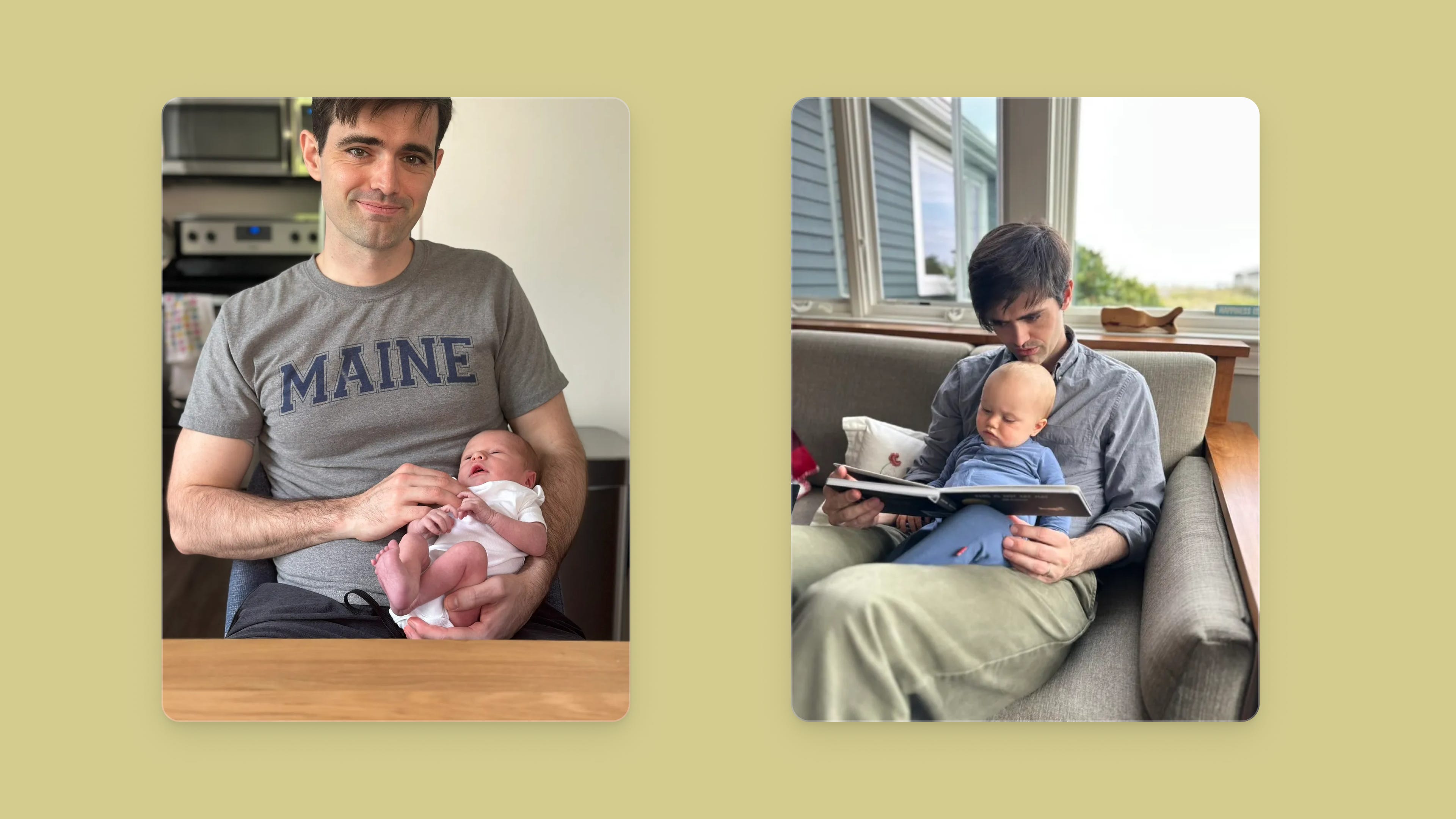
This year was Colin’s first Father’s Day as a dad. I wanted to give him something special.
From my janky prototype and interminable feedback, he built a real iOS app, with offline mode, multi-user syncing, and OAuth sign-in.
Which perfectly encapsulates his presence throughout this past year. He woke up with me for the 3 AM feedings; he made sure I never had to think about groceries or dishes; he set a series of all-time step count records walking around the neighborhood with a baby who refused to sleep when not in motion strapped to his chest.
Inspired by his newfound technical prowess, I also wanted to attempt a technical feat that had always intimidated me: hardware. So I got a Raspberry Pi and an e-ink display, pulled excerpts from those early notes, rendered them in a font made from my own handwriting, and paired each excerpt with a collage of photos from the day I recorded it.
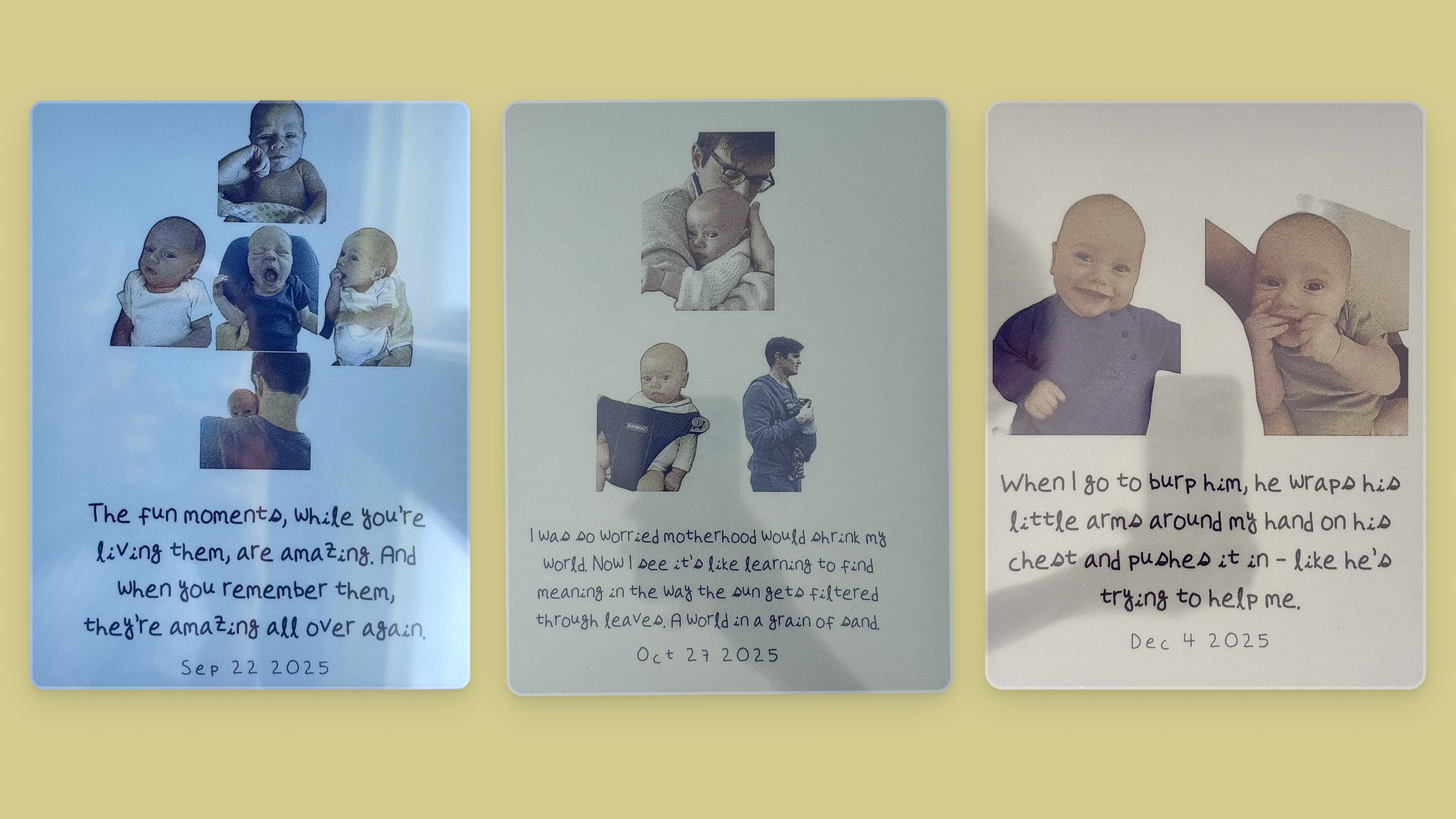
It was such a fun way to revisit the many big and small milestones from our first year as parents, and to see my own thoughts lined up with the data- and photo-backed log of what was happening. As I said on September 22, two weeks postpartum:
The fun moments, while you’re living them, are amazing. And when you remember them, they’re amazing all over again.
Life often feels made up of difficult choices. Should I record this experience, or should I be present in the moment? Should I build the thing I want to build, or the thing I know will make money?
Often, these only feel like choices because we are working under constraints we may not realize we can bend. Stepping into motherhood, for me, was an exercise in questioning constraints. Colin and I became parents and we became more technical and we became more creative and, because of all of these things combined, we built something we love.
I might not remember dragging the bassinet up and down the stairs 11 months ago. But I remember, when I would go to burp him, and he would wrap his little arms around my hands like he was trying to help me.
xoxo,
hils

against socratic management

The management trainings are right about one thing: you do not want your team to rely on you to solve every problem, or to repeatedly defer to your judgment instead of developing their own. But open-ended questions are not the only alternative to handing someone the answer.
get your household out of your head

I have a new three-hour virtual workshop coming this fall: Build Your Household OS.
The e-ink display with photos and quotes is such a beautiful idea! Would love to hear more about other experiments in creative expression with GenAI.